Begging on the Corner
"A heart without charity is suffering from a sickness more troubling than anything physical."


The man stood next to my car at the stoplight with his cardboard sign. His eyes were shifty. He moved his lips over toothless gums. Long disheveled gray hair swung over army fatigues. He clomped over to my Volvo in worn brown boots.
I didn’t want to roll down my window. I just wanted to go home.
I had just left the church hall, where I had sorted clothing donations for our Ladies of Charity children’s closet.
I want to throw my head back in laughter at the absurdity of that contradiction.
The stoplight is a long one for our small town.
I rolled down the passenger-side window, smiled, and handed him some cash. It wasn’t much. It wasn’t enough for a stay in a hotel, a load of groceries, or even a good meal.
It pacified my guilt. It solidified my title: Lady of Charity.
I didn’t give from the last stores of my wealth. I didn’t offer to give him a ride or provide him with information about homeless shelters.
I stuffed a wad of bills into his hands so I could stifle my conscience and hurry home.
Charity can be a loaded word. It is a handout that no one wants to receive, a sort of philanthropy, even a place where people can go for help. It is often an action instead of a way of acting.
I give my quota. I write the checks. I do the volunteer work. I care for my young granddaughters and help my elderly homebound parents. But I tally the time. Surely I have given enough. Surely I deserve to reserve some of my wealth and my time for my own satisfaction.
Pope Francis, widely known for his compassion for the homeless and the destitute, said, “Charity that does not change the situation of the poor isn’t enough.”
And charity that doesn’t change the state of our hearts is not enough either. I cannot go into the world as a servant to the poor and truly see into the souls of the suffering if I cannot adopt a spirit of charity within my own household.
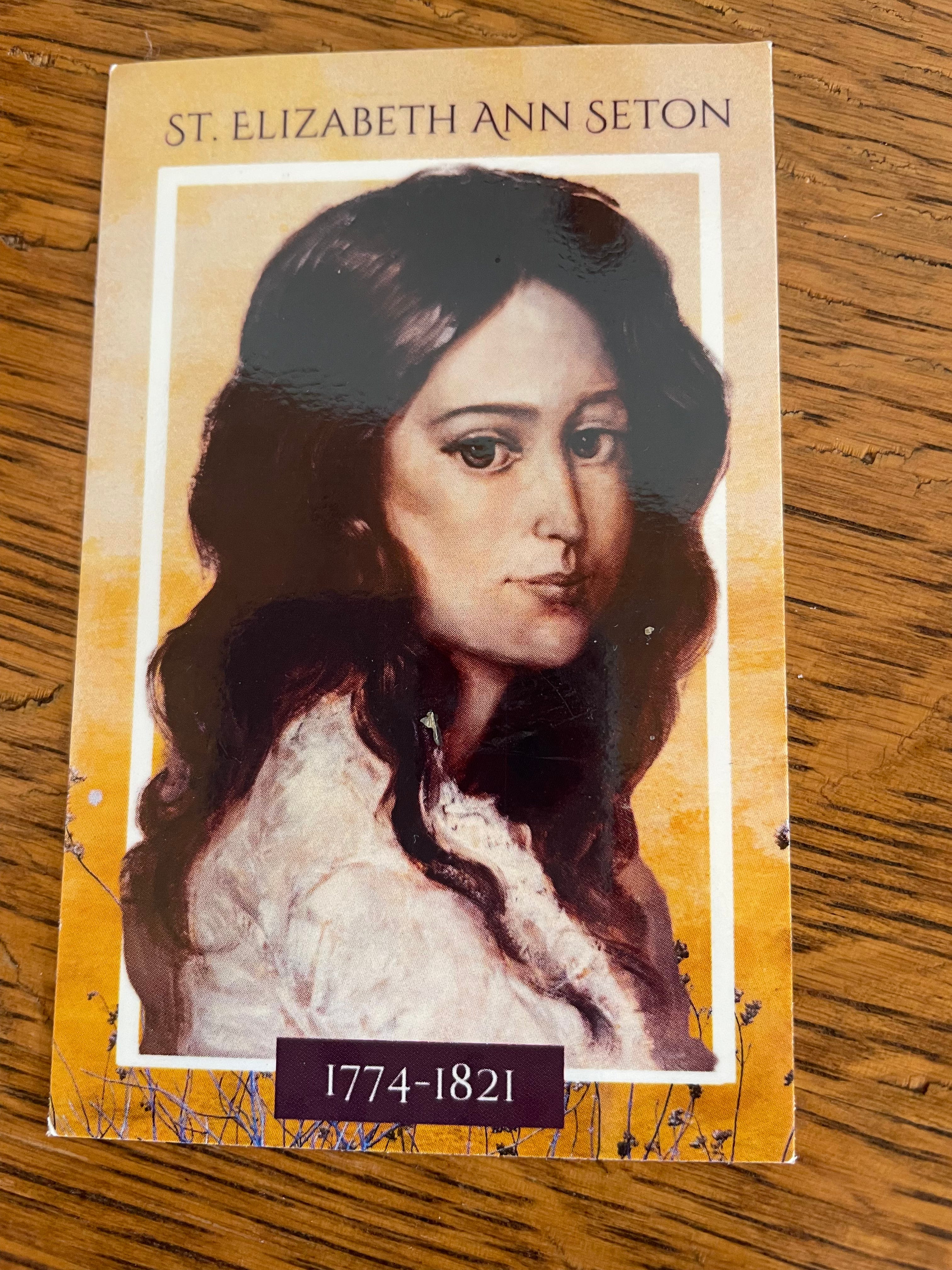
St. Elizabeth Ann Seton, the founder of the Sisters of Charity of St. Joseph’s and the first free Catholic school in the United States, spent her life caring for others. Born into a well-to-do Episcopalian family, she converted to Catholocism and left comfort behind. She was widowed at age 28, lost two of her five children in their teenage years, and had many other severe challenges as she cared for orphans and the students in her school in Emmitsburg, Maryland. Her heart was disposed to a deep unadulterated concern for the wellbeing of everyone in her care. When writing about charity, she repeated the teachings of St. Vincent de Paul, that a heart without charity is suffering from a sickness more troubling than anything physical.
I picked up the above image of St. Elizabeth a few years ago when I visited her shrine in Emmitsburg. Most prayer cards depict her in religious clothing. She looks almost unapproachable. This rendering made me imagine what it might have been like to be loved by her.
How do we become truly charitable? How do we leave our opinions, our judgment, our selfishness behind so that our hearts can reach out in a compassion that is given freely to everyone we come into contact with?
I served on our local homeless shelter board for a number of years. I also have people close to me who have roamed the streets. Those who work with the homeless and those who know them will agree that, in many cases, untethered mental illness forces people into homelessness.
The Catholic patron saint of homeless, beggars, and the mentally ill, Saint Benedict Joseph Labre, was revered by some in his day, but many rebuffed and ignored him. Known as the “begger of Rome,” Labre wandered around the city, begging and praying. He was often seen sleeping near Cathedrals, shrines, and historic ruins, like the Colosseum.
How many people passed him by, fearful of his ranting, repulsed by his smell, disgusted by his need to beg rather than work? How many passed holiness by without the thought of charity?
I shared a brief conversation with the homeless man. He thanked me to the point of embarrassment and then moved on to plead with drivers in the cars behind me.
Windows remained closed.
He moved back past me and leaned in to wave again. He shuffled back and forth past my car several more times, each time bowing his head at me in thanksgiving.
I felt awful.
I didn’t deserve thanks. I didn’t deserve his public displays of affection.
If my son or one of my daughters were begging on the street, what would I want people to give?
How would I want them to be loved?
Lord, let me see holiness.
Hard question: if it were my son or daughter what would I want people to give? 🙏
Being both Catholic and Asian, I feel I should have double dose of guilt, but I don’t. Sometimes I think something’s wrong with me. Maybe because I’m not originally a Catholic? I don’t know how to explain the Asian part — I AM originally Asian. When I read your piece, I thought about a video I saw recently where this person debated whether he was going to give money to begger or not and whether he thought the begger was going to use the money for drugs or alcohol. Then he felt convicted about the many times he himself wasted money.